

The Visibility Gap: Why Deep Expertise Gets Buried and What Actually Works
You've spent years building expertise and solving real challenges. Delivering results that 'should' speak for themselves. You've crafted and combined expertise at a level that most people in your industry may never reach.
And yet, when it comes to being visible, you feel like you're shouting into a void... It's the visibility gap that keeps you small when an iceberg of expertise you're capable of is mostly beneath the surface.
You've tried all the things you've been told to try. You've posted on LinkedIn, Meta, X and maybe even tiktoc. You've thought about your "personal brand", and probably cringe at the word 'influencer'. You've sat through webinars about content strategy and hook writing and algorithm hacks. Maybe you've even hired someone to help you with it.
And something about the whole thing has never felt right.
Not because you haven't given it a shot or you're bad at it. Not because you lack discipline. Not because you need a better content calendar or a more compelling headline formula.
Because the system you've been told to build your professional visibility on wasn't designed to do what you need it to do... and that's not a marketing or motivational reframe. It's a structural observation. And once you see it clearly, a lot of it might start to make sense.
The goal is not to “beat the algorithm.”
The goal is to understand what each platform is designed to reward, then create content that matches both the platform and the person you want to reach.
None of those reward signals correlate with depth of expertise, quality of service, or the kind of trust that actually leads to a professional relationship.
This is the visibility gap. It's not a gap in your skills or your commitment. It's a gap between what the platform is designed to optimise and what you actually need it to do.
You're trying to use a tool that was built to sell attention as if it were built to build reputation. And when it doesn't work, the industry tells you the same thing: post more, post better, learn the algorithm, show up daily.
The solution to the platform not working is always more platform.
That's not strategy. That's a treadmill.
Your audience is experiencing the same thing
Here's the part that rarely gets acknowledged: the experienced professionals and business owners you're trying to reach are dealing with the same overwhelm you are.
They're running businesses. Managing teams. Navigating their own transitions. They're not spending forty minutes engaging thoughtfully with posts in their feed. They're scanning, scrolling, and occasionally stopping when something cuts through the noise.
But "cutting through" on a platform means competing with every other voice in the feed, including the voices that are engineered for engagement rather than substance. The hot takes. The rage bait. The "5 lessons I learned from failure" posts that are optimised for clicks, not for the person who actually needs help.
Your depth is a disadvantage in that environment. The thing that makes you valuable to a client, your nuance, your precision, your ability to see what's underneath the surface issue, is the same thing that makes you invisible to an algorithm that rewards simplicity, speed, and emotional charge.
So you're creating content that the very people you're trying to reach don't see. Not because they don't want to or aren't interested. Because they're overwhelmed with their own lives and businesses, scrolling past a feed that's been engineered to prioritise volume over value. So unless they're specifically looking for what you offer and using the same search terms you've used you'll hear crickets from those carefully crafted articles and post.
That's not a marketing failure. It's systems designed that way and doing what they're built to do. And it helps to understand it this way so you can better direct your efforts.
What you're actually building on
Every hour you spend creating content for a social media platform, you're building on rented land.
The platform owns the distribution. The platform owns the data. The platform decides who sees your work, and it changes those rules regularly. Your content's reach is determined not by its quality but by how well it serves the platform's engagement targets on any given day.
You don't own the relationship with your audience. The platform does. And if you've ever noticed a post that took you two hours to craft reaching 47 people (most of whom are other coaches and content creators), you've already experienced what that means in practice.
This isn't an argument against using social media. It's an argument against centring your entire visibility strategy on something you don't control.
There's a meaningful difference between using a platform as a distribution channel and building your professional identity on top of it. The first is strategic. The second is precarious.
The mechanism that actually works
Strip away the marketing theory for a moment. Look at how high-value professional relationships actually begin.
For most established professionals, the best clients, the best partnerships, the best opportunities didn't start with a social media post. They started with a warm introduction from someone who knew both parties. Someone who listened to what was needed, remembered who in their network had that capability, and made the connection.
These people have a name, though it's rarely used outside of network theory: super connectors.
Super connectors aren't networking for sport. They're not collecting contacts or building audiences. They have a specific way of operating: they listen carefully, they remember what people need, and they make introductions without being asked and often without expecting anything in return. They're curating human capital based on trust and pattern recognition.
The irony is that platforms like LinkedIn were originally designed to facilitate exactly this kind of connection. But the platform's evolution toward content creation and engagement metrics has buried the connectors beneath a layer of people performing thought leadership. The people doing the real connecting are often the quietest profiles in the feed.
You probably already have super connectors in your network. They're the ones who follow up after a conversation with "you should talk to..." rather than "let me add you to my CRM." They're the ones who remember what you mentioned needing six months ago and send you a relevant contact unprompted. They don't post about connecting people. They just do it.
These relationships are worth more than any content strategy. And most professionals walk right past them because they've been told that visibility means content, not connection.
The trust chain
When a super connector introduces you to someone, something specific happens that no amount of content can replicate: trust is transferred.
The person you're meeting doesn't need to evaluate your credibility from scratch. They're borrowing the trust they already have in the connector and extending it to you. That's why the first conversation feels different from a cold enquiry. The ground has already been prepared.
What happens next matters just as much. The conversation isn't a pitch. It's diagnostic. You're listening for the gap the person can't see themselves, and you're reflecting it back. That's where trust deepens, not in a content calendar, in the moment where someone feels genuinely seen and understood.
This is how my best professional relationships have started. An introduction from someone who saw a fit. A conversation about what the person actually needed, not what I was selling. A discussion about how I'd approach meeting that need, and how we'd work together. At no point in that sequence did content performance or algorithmic reach play a meaningful role.
The platform might have been where the connector initially encountered me. But the mechanism that converted the relationship wasn't the platform. It was the human chain: trust transferred from connector, deepened through conversation, confirmed through the ability to see what wasn't yet visible.
That's not a sales funnel. It's a trust chain. And it's fundamentally incompatible with the way platforms want you to operate, because platforms need you to broadcast to many in order to reach a few. This model is the inverse: reach a few of the right people through someone who already trusts you, and go deep immediately.
Rented reach vs owned reputation
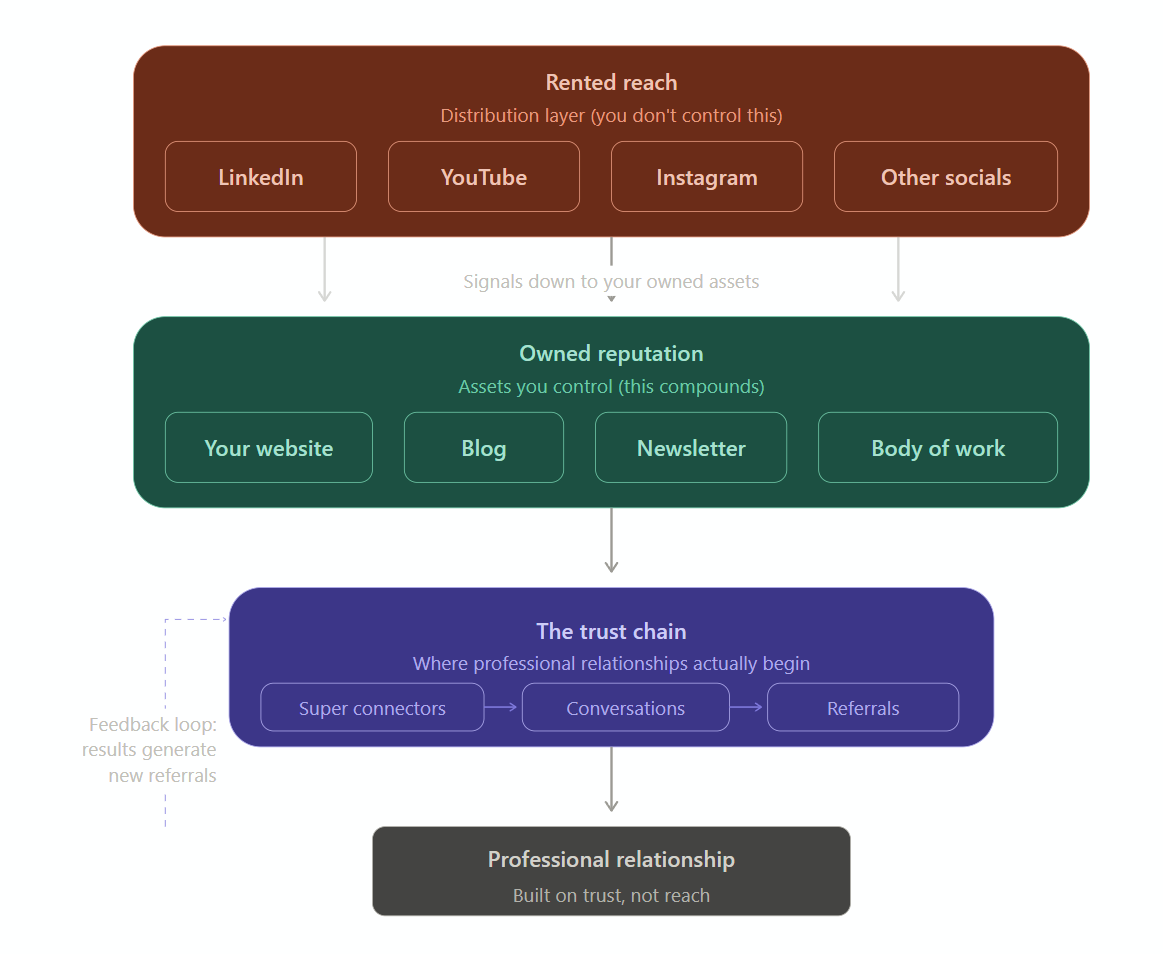
There are two fundamentally different approaches to professional visibility. Most people have been taught only one of them.
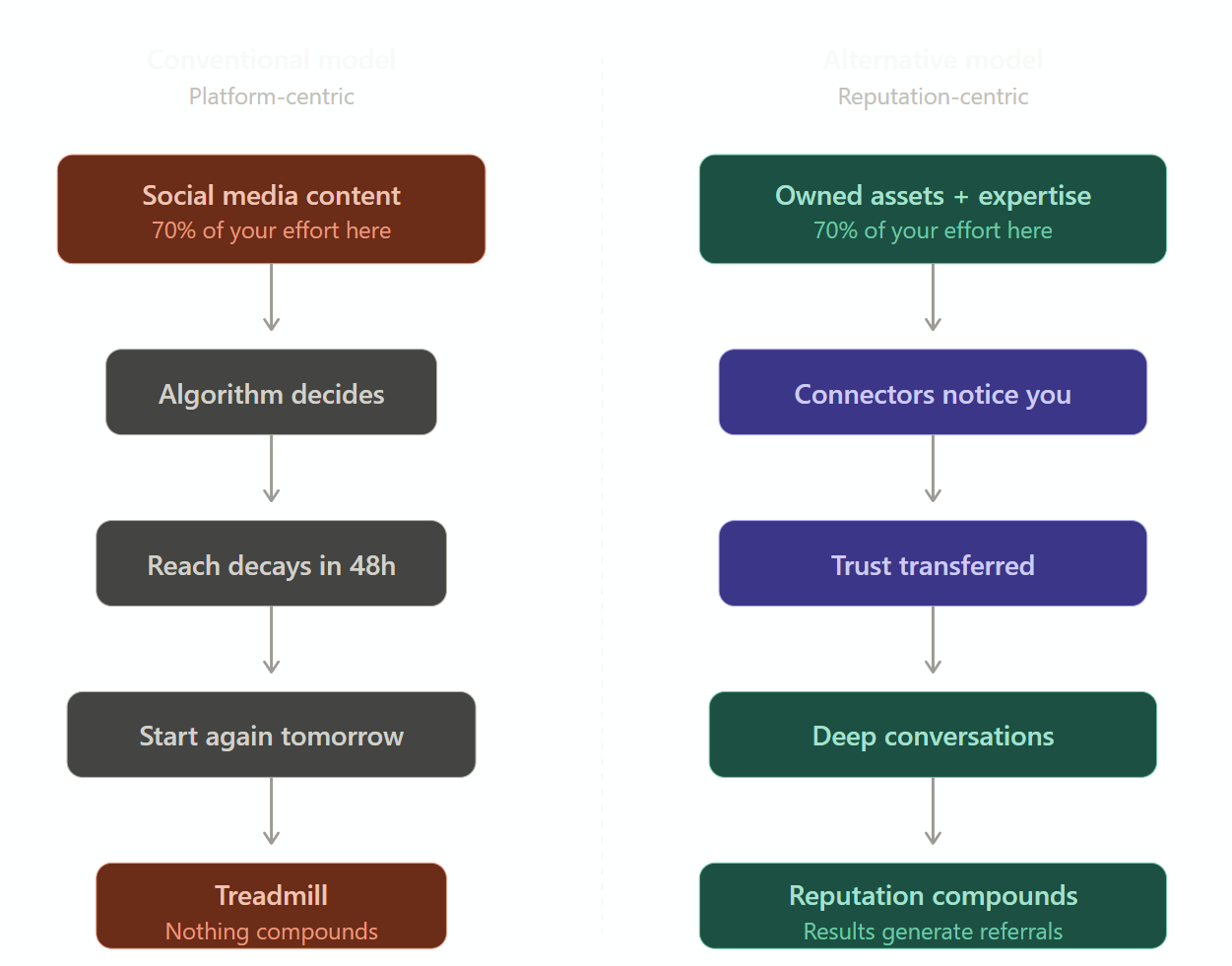
The conventional model is platform-centric. You put 70% of your effort into social media content. The algorithm decides who sees it. Your reach decays within 48 hours. You start again tomorrow. Nothing compounds. It's a treadmill, and the only way to stay visible is to keep running.
The alternative is reputation-centric. You put 70% of your effort into owned assets, your website, your blog, your newsletter, your body of work, the things you control and that compound over time. You use social media as a distribution layer, a signal that points people toward your owned space, not as the destination itself. And you invest in the human infrastructure, the connector relationships and conversations, that actually generate professional opportunities.
The difference isn't just strategic. It's architectural. One model leaves you dependent on a system you don't control. The other builds an asset that grows whether you post today or not.
What this looks like in practice
I can speak to this directly because I've been living it.
Over the past two months, I haven't posted on social media on my normal schedule. Not because I'm burned out on it, and not just as some kind of experiment. I've been building owned assets: the State Shift diagnostic, the Transformation Archetype self-assessment, and long-form blog content on my own website.
No guilt. No anxiety about falling behind. No sense that the business was suffering because I wasn't "showing up" in the feed.
Here's what I was doing instead: building content on a domain I control, structured for how people actually search and ask questions right now, including through AI-powered search tools. This matters because the landscape of how people find expertise is shifting and fast. LinkedIn has blocked AI search crawlers from indexing its content. Which means that if your professional thinking lives only on LinkedIn, it's invisible to an entire emerging layer of discovery... except if you search linkedin itself... there's a lesson there!
The platforms want to ensure they're the ones currating the content, while you getting found for it as an author is just the misleading carrot, as they collect the expertise in the background.
The blog content I've been building is findable, permanent, and mine. It doesn't decay after 48 hours. It doesn't depend on an algorithm to reach the right person. And it's structured to surface when someone asks a question that my expertise can answer, whether they ask it on Google, through an AI assistant, or in a conversation with someone who remembers reading it.
That's not a content strategy. It's an infrastructure and IP based decision.
The guilt is engineered
If you've ever felt guilty about not posting, it's worth understanding where that feeling comes from.
Social media platforms use a specific behavioural mechanic: variable reinforcement. When you post consistently, you receive intermittent rewards, a spike in engagement, a new follower, a comment from someone you respect. When you stop, those rewards disappear and your reach drops. When you start again, the platform rewards you with a temporary boost. Stop, punish. Start, reward.
This is the same mechanic that keeps people engaged with any intermittent reward system. It's not accidental. It's engineered into the platform's design because it drives the behaviour the platform needs: consistent content production.
The guilt you feel about not posting isn't a signal that your business needs you to post. It's a signal that the platform's reinforcement loop is working as designed.
Your audience, meanwhile, responds differently. The people who have genuinely connected with your work, who consider your thinking part of how they navigate their own challenges, they notice when you're absent. Not because the algorithm told them to notice, but because you mattered to them as a human being. Some will reach out and ask if you're okay. That's a relationship. That's what an algorithm can't manufacture.
Acknowledging the super connectors
One of the most undervalued dynamics in any professional network is the person who connects people.
Not the person who collects business cards at events. Not the person who posts about "the power of networking." The person who quietly, consistently, and without fanfare sees complementary capabilities between two people and makes the introduction.
These people exist in every industry, and they're almost never recognised for the value they create. The executive search firms, the Egon Zehnders and Heidrick and Struggles of the world, have built global businesses on formalised versions of this capability. Venture capitalists at the early stage do it instinctively, connecting founders with talent, advisors, and customers. The best executive assistants and chiefs of staff do it inside organisations, routing the right people toward each other without anyone noticing.
But the informal super connectors, the ones in your LinkedIn network, your professional community, your personal circle, they're doing the same work without a title, a fee, or a platform. They do it because they see people clearly and they value the act of creating a useful connection.
If you're reading this and you recognise someone in your network who operates this way, acknowledge them. Not with a public shoutout or a LinkedIn tag. With a direct message. A genuine thank you. An offer to be useful to them in return. These relationships, built on mutual recognition and genuine respect, are the most durable professional asset you'll ever have.
And if you're reading this and you realise you don't have super connectors in your network, that's not a personal failing. It's a gap that can be addressed. It starts with being genuinely curious about the people around you, remembering what they need, and making introductions when you see a fit. The connectors in your network will find you when you start operating the same way.
Social media is not the enemy, but use it for what it was built for
Let me be clear about something: this isn't an anti-social-media argument.
Social media is a valuable distribution platform. It's how many people will first encounter your thinking. It's where connectors may initially come across your work before deciding to introduce you to someone. It's a signal layer, a way of being findable and legible to the people who might need what you do.
What it's not is a foundation. It's not a place to build your professional identity. It's not a substitute for owned assets. And it's not the primary mechanism through which deep professional trust is built.
The distinction matters because it changes how you use the platform. Instead of trying to make social media do the whole job, you use it to point people toward the places where your thinking lives permanently, your website, your blog, your body of work. You share enough to be findable. You reference your deeper work. You let the platform serve as a doorway, not a destination.
That shift, from centring your strategy on the platform to using the platform in service of your strategy, changes everything. It reduces the pressure to post constantly. It eliminates the guilt of going quiet when you're building something. And it means that the time you do spend creating content is in service of an asset you own, not one you're renting.
What changes when you see this clearly
When you understand the visibility gap structurally, several things shift.
The frustration of low engagement stops feeling like a personal failure and starts looking like a predictable outcome of a design mismatch. You're not doing it wrong. The system isn't doing what you need.
The pressure to post daily, to keep up with the feed, to perform thought leadership on a schedule, loosens its grip. Because you can see that the pressure isn't coming from your business needs. It's coming from the platform's needs.
The people in your network who've been quietly making introductions, sending referrals, and connecting you with opportunities come into sharper focus. You start recognising the trust chain that's been operating alongside your content strategy the whole time, and you start investing in it deliberately.
And the question shifts. Instead of "how do I get more reach?" it becomes "how do I make my expertise findable, my values visible, and my way of working legible to the people who need what I do?" That's a fundamentally different question. And it leads to a fundamentally different strategy.
One that's built on depth, not volume. On trust, not reach. On owned assets, not rented platforms.
In the next article in this series, I'll walk through what that strategy looks like in practice: how to build a professional presence that compounds over time, how to structure your owned content for the way people actually search now, and how to use social media as a distribution layer without letting it become the centre of gravity.
If you've been feeling the tension between knowing your value and struggling to make it visible, that tension is valid. And it's solvable. It just requires a different architecture than the one you've been handed.
[Book a discovery call](https://calendly.com/altworkspace) and let's talk about what that looks like for you.
**Related reading:**
→ [How do I reinvent myself? The identity shift that changes everything](https://altworkspace.com/how-do-i-reinvent-myself)
→ Article 3 (coming soon): The practical build
